
Why Boring Introverts Are Supermen in Disguise
They don't cower to kryptonite

I think the most powerful people in the world are the ones nobody notices at parties.
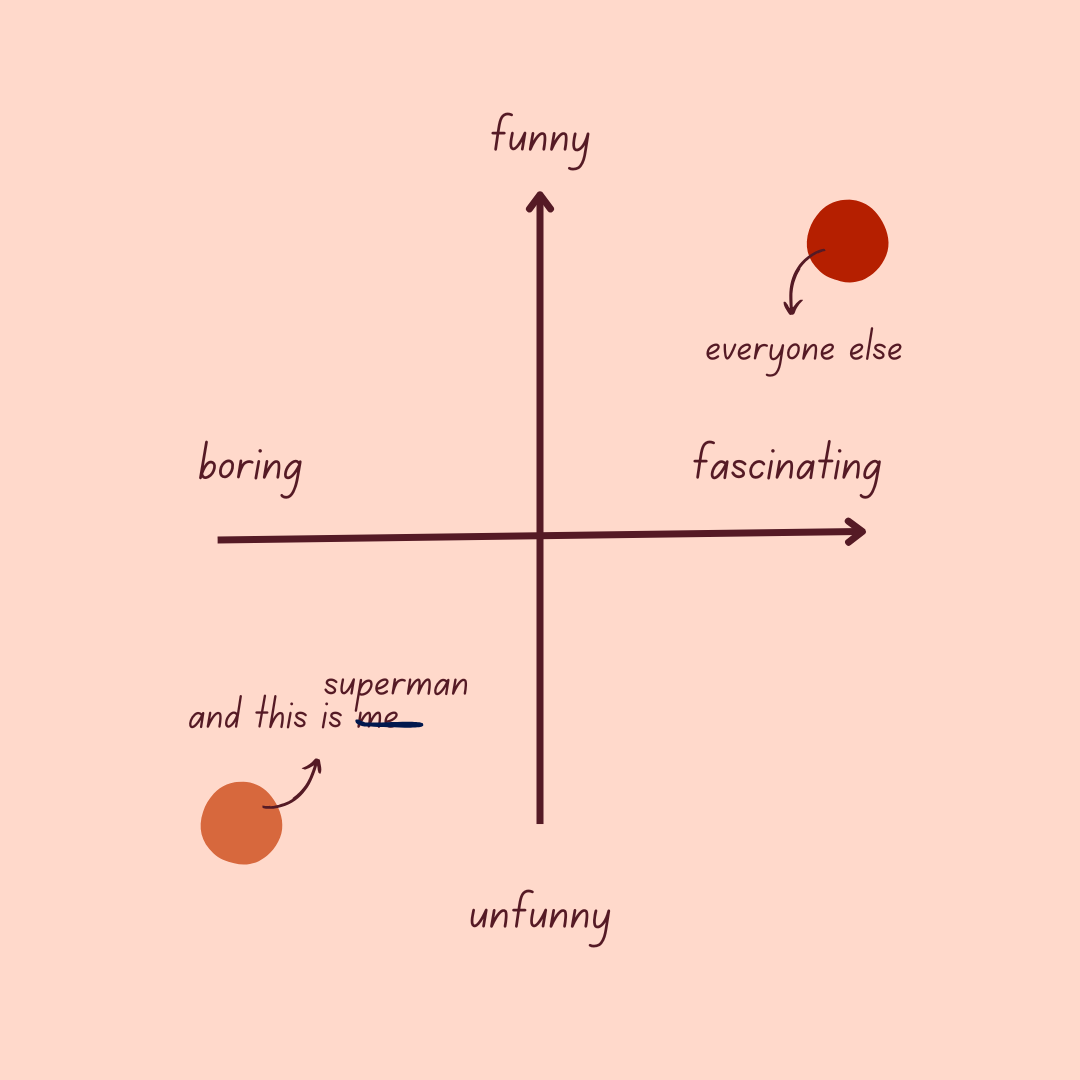
Not the charismatic speakers. Not the ones with a thousand stories and magnetic energy. I mean the quiet ones standing near the bookshelf, the ones who leave after forty minutes, the ones people forget were even there.
Because what looks boring on the surface is actually a kind of superpower running underneath.
Last month, I spent 11 days reorganizing my Notion workspace.
Not because it was broken. It worked fine. But I got this itch to understand how information flows through my life. So I mapped out every database, every relation, every filter. I watched a ton of tutorials on database architecture. I sketched diagrams on paper, trying to figure out the perfect tagging system.
My friend saw my screen during a video call and said, “Dude, are you seriously still doing that Notion thing?”
Yeah. I was.
And when I finally finished, nobody knew. There was no before-and-after post. No celebration. Just me and my perfectly structured second brain, humming quietly in the background of my life like a well-tuned engine.
Maybe you feel this way, too.
Maybe you’ve spent hours on things that would bore other people to tears, and felt completely alive while doing it.
To most people, this looks like wasted time. “Why don’t you just use it instead of organizing it?” they ask. But to be honest, these invisible projects are where I feel most like myself.
But you can’t manufacture this kind of focus artificially.
You can’t wake up tomorrow and say, “today I’ll spend 8 hours perfecting my email signature.” It either pulls you in or it doesn’t.
When I was nineteen, I discovered David Foster Wallace.
There were others who influenced me too, like Joan Didion and Zadie Smith and George Saunders. But Wallace was different.
Not just because he wrote thousand-page novels with hundreds of footnotes, but because he showed me what introvert intensity actually looks like when you stop apologizing for it.
In one interview, he said something that rewired my brain:
“The truth will set you free. But not until it is finished with you.”
When I read that, I said to myself: I want that.
I wanted the willingness to sit with difficult truths until they revealed themselves. To not rush. To not perform. To let the boring, repetitive, invisible work of thinking actually finish its job.
And I doubt if anything has shaped my life more than that realization.
Why boring is good for your soul?
People who feel too much and think too deep—we crave the permission to be boring. We crave it like a plant craves darkness for its roots to grow.
Because being boring revives the part of us that society tries to kill.
The part that doesn’t need to be interesting every moment.
That knows entertainment and depth are not the same thing.
That remembers you can be utterly ordinary on the outside while galaxies are forming inside your mind.
History is filled with people who looked boring and changed everything.
Charles Darwin spent 20 years studying barnacles. Twenty years. On barnacles. People thought he was wasting his genius. But that boring, meticulous work taught him how to see patterns in nature that led to the theory of evolution.
Emily Dickinson barely left her house for decades. She wore white dresses and baked bread and tended her garden. To her neighbors, she must have seemed like the most boring woman in Amherst. But inside that quiet life, she was writing poems that would outlive empires.
Franz Kafka worked a day job in insurance for 14 years. He’d come home, eat dinner alone, then write in his room until late at night. No parties. No networking. Just the boring routine of showing up to his desk in the silence.
Being boring is a superpower.
It lets you disappear from the exhausting performance of being interesting. No clever remarks required. No pressure to have the best story. You just exist, quietly, while your mind does the real work.
The world runs on people like this.
The ones who can sit in a library for six hours.
Who can debug code until 3 AM.
Who can edit the same paragraph seventeen times.
Who find genuine pleasure in spreadsheets, filing systems, research rabbit holes.
Being boring is good for the soul because it gives you back your attention.
You stop scattering yourself across a hundred shallow interactions. You stop trying to be memorable. You become invisible, which means you become free.
And for hours or days, you build something that matters in the only dimension that counts: the internal one. Like a submarine running silent and deep while the surface world spins on without you.
It fills you with something the extroverted world can never provide. A sense of completeness that comes from finishing what you started. A quiet satisfaction that doesn’t need witnesses. A feeling that you grew, not louder, but deeper.
And that, at least for me, is the only kind of growth that lasts.
And then... someone asks what you did this weekend.
“Not much,” you say. “Just stayed in.”
They nod, already bored by you. They don’t know you spent 12 hours learning about Byzantine architecture or finally understanding how async functions work or writing 4,000 words about your grandmother’s hands.
The wave pulls back. The visible world returns. We go back to seeming ordinary.
But deep down we know: we’re not boring. We’re submarines. And submarines don’t need to make waves to be powerful.
And, that’s life.
Years ago, I became obsessed with understanding why introverts feel they need to apologize for their nature. Why we think building slowly, thinking deeply, and working quietly means we can’t build successful businesses. It consumed me for months, then years. And when it finally gave me clarity, I wrote a guide about it.
It’s called Why You Should Go For Your Dream Today.
It’s for introverts who want to build freedom without burning out. For the ones who know their deliberate nature is an advantage, not a weakness. For people who are ready to stop waiting for permission and start building their runway.
Get your copy HERE.
Because boring introverts don’t need to become extroverts to succeed. We just need to build systems that work with our nature, not against it.
Stay blessed,
Aritra