
This Is How You Put Yourself Back Together After Burnout
Read this only if you've experienced burnout and there are days you don't know how to articulate or work. Read this if you want to say "FUCK IT" but can't

Welcome to the fourth September issue of Introvert Not Out.
Quick favor — if you see this email in your Promotions tab, please move it to your Primary inbox. That way, you won’t miss out on future issues.
The day I finally broke, nothing dramatic happened. I think that was the scary part. One moment I was answering client emails, the next I was staring through my screen, hollow and paralyzed. I simply could not continue.
After a lifetime of wrestling darkness, 2025 became the year I met real burnout. I’d lived with depression on and off since my teens. I knew its fog by name. But burnout was a different beast.
Depression, at least for me, came with heavy sadness or numb days I eventually swam through. Burnout was the absence of everything. No sadness but just an empty “off” switch inside me. I wasn’t actively suicidal but I just didn’t care if I existed. And if you’ve been there, you know that eerie quiet it brings.
As an autistic kid (Asperger’s, though I didn’t have that word growing up), I learned to find safety in routine and patterns. Chaos was my kryptonite. And 2025 was nothing but chaos.

The ground kept shifting.
Artificial intelligence went from niche novelty to looming tsunami. One minute I’m running a content marketing agency writing for B2B clients and the next I’m hearing how ChatGPT-style tools could churn out content in seconds.
I watched colleagues feed years of their creativity into training models that then replaced them.
I saw companies treat human writers and artists like obsolete parts told to “document your process for the AI” as if writing our own obituaries.
Every week there was a new tool, a new skill to learn or fear. I’d lie awake with thoughts looping:
How do I stay relevant?
Will my clients quietly replace me with a bot next quarter?
For someone who thrives on predictability, this was torture. And it wasn’t just tech. Social media turned into a performative circus that made my head throb.
Scrolling LinkedIn for five minutes felt like walking through a graveyard of forced smiles. My feed was full of people pretending everything’s fine and humblebrag success stories that smelled like fairy tales. It was mentally corrosive. I knew many of these folks offline; I knew they were struggling, yet online they crafted success narratives out of pure fiction.
I run a content marketing agency, so visibility isn’t optional. I’ve played the LinkedIn game too. But every post and perky comment cost me more energy than I had. It all started to feel like screaming into the void just so I wouldn’t be forgotten.
I was disenchanted and angry.
Angry at a culture that equates exhaustion with virtue.
Angry at myself for ever buying into it.

Eventually, something had to give.
My breaking point was deceptively quiet.. Just a gentle, terrifying whisper inside that said: “You can’t go on like this.” I’d been holding my breath for years and now I was out of air.
In the aftermath, I tried to fix myself the only ways I knew how..
On that note I’ve spent the last few months creating a book that will help you find clarity with some kickass frameworks.
Get it HERE! YES IT’S FREE :))
STEP ONE TO HELL
First, I worked even harder. (Brilliant strategy, right?)
If I was drowning, maybe I just needed to swim faster.
I took on new projects and stayed up late with my team.
I convinced myself I could outrun the emptiness with sheer effort.
But I couldn’t.
The harder I ran, the harder I hit the wall when my energy gave out.
STEP TWO TO HELL
I even tried faking positivity.
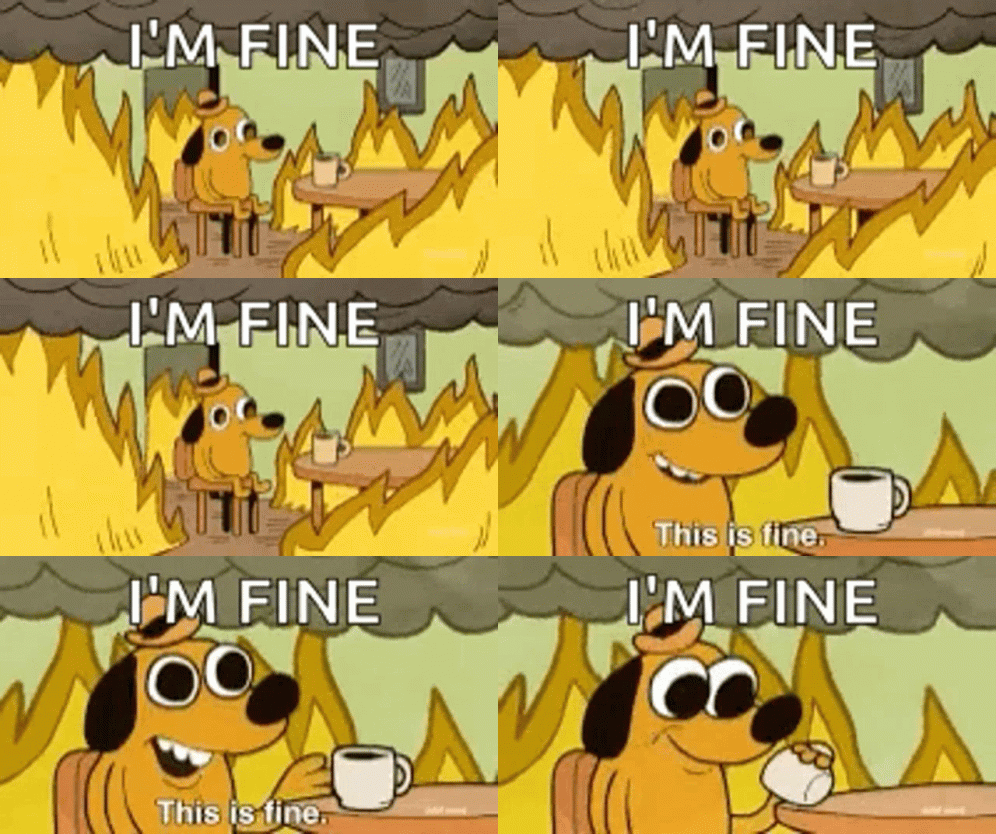
I forced myself to keep posting the upbeat highlights on LinkedIn, responding to “How are you?” with “All good, just busy!”
Looking back I was awfully courteous. I thought if I acted okay, I’d eventually be okay.
That might work for a short burst, but it’s soul-poison over time.
Every post, every networking event where I plastered on a grin, just deepened the disconnect between the life I presented and the life I felt.
It’s a special kind of loneliness, being applauded on the surface while you’re quietly falling apart underneath.

None of these “solutions” worked.
Working harder just accelerated the collapse.
Waking up at 5 AM just made me sick.
Pretending just made me feel like a fraud.
Burnout isn’t something you can brute-force or hack with a new schedule. I learned that the hard way.
So I stopped.
I waved the white flag internally. For the first time in my adult life, I did nothing productive for a while. And that was terrifying. Jarring especially to a polarised TYPE A person like me.
One afternoon, I shut my laptop and just left. I walked out of my home office and went to the park without my phone. I remember it was a warm late summer day. I sat on a bench feeling like a deflated balloon, and I probably looked lost. But as the minutes passed, something strange happened:
I noticed the world again.
The sound of wind in the trees, children laughing in the distance, the rhythm of my own breathing. It was as if I’d been living in fast-forward and someone finally hit pause.
I wish I could say I had a grand epiphany on that bench, but I didn’t. What I did feel was the smallest spark of relief. A glimmer of okay-ness in simply existing with the sun on my face and nothing to do.
That was the beginning of my recovery, though I didn’t know it then.
I went home and slept – truly slept – for the first time in months.
In the days that followed, I started experimenting with something I never had before: “getleness: Instead of berating myself to “snap out of it,” I treated myself like I’d treat a friend who was broken and exhausted. I gave myself permission to go slow.
Practically it looked like this:
I began most mornings by playing soft instrumental music – gentle piano, ambient nature sounds – before I ever looked at my email. The news, the pings, the world could wait an hour. I’d sit by the window with my coffee (the good coffee, not that instant junk I’d been settling for) and listen to the birds or rain sounds. Sometimes I wrote in a journal, mostly nonsense, just to let my brain breathe on paper. Other times I simply did nothing and let my mind drift. It felt ridiculously self-indulgent at first. I kept waiting for the guilt to crash in – you should be working! hustling! accomplishing! – but the guilt started to fade as I realized these little moments were healing me.
I started taking walks again. Slow, aimless walks with no podcast, no step-count target. Just me wandering my neighborhood like I did years ago, noticing houses, saying hi to stray dogs, feeling my body move.
The first few times, I was so preoccupied with “I should be productive” thoughts that I almost turned back. But I pushed through, and it got easier. The fresh air cleared some cobwebs.
I also reconnected with reading – not industry articles or Twitter threads, but real books. As a content creator, I’d stopped reading for fun because I was always creating or consuming bite-sized info online. Picking up a physical paperback with that old-book smell was like meeting an old friend. In its pages I could escape the noise and live in someone else’s world for a while.
It reminded me why I loved words in the first place.
Gradually, I built a routine – if you could even call it that – of gentle habits.
Wake up at a time my body seemed to like (often 7 or 9 AM, not 5).
Make the bed just to give myself a small win.
Drink water.
Play music while I work, but stop to stretch whenever my shoulders creep up to my ears.
In the afternoons, if I hit a wall of fatigue, I took a nap for 30 minutes.
Sometimes I literally lie on the floor and do nothing, staring at the ceiling.
And in the evenings, I disconnect. I log off work by a sane hour and actually log off – no cheeky email check at midnight.
I put my phone in another room so I’m not tempted by every notification. The world can survive without me for one night. I’ve learned it always does.
None of this is groundbreaking. You won’t see a TED Talk titled “Do Less, Achieve…Peace.” I chuckle at how unimpressive my new rhythm would look on paper. But it’s mine, and it’s working.
Little by little, the embers of creativity are coming back. I find myself jotting down ideas again solely because I have something to say. I even am feeling a flicker of that old joy the other day: the joy of writing for its own sake, the way I did before.
It felt like meeting an old part of myself and saying, “Hey, I missed you.”
Oh yes, I also reached out to people I trust. I’m an introvert but I still need connection, just the real kind. I stopped networking and started talking. I confessed my state to a couple of close friends and my wife.
Told them how bad it really was.
Those conversations were hard. I was the one people come to for solutions and here I have to choke out the words “I’m not okay”
But that was the turning point.
One friend now checks in on me every week, and he knows when I say “I’m fine,” I might be lying. He isn’t fooled by the polite smile. He’ll reply, “No, how are you really?” and let me talk or cry or sit in silence on the phone.
My wife, bless her heart, didn’t try to “solve” me. She just listened and held space. She started dragging me on evening walks (even on days like today when I’m a bit off) because she knew it helps me.
These honest relationships became a lifeline.
When you tell the truth about not being okay and someone says “I’m here” in response, you feel “SAFE”. As a grown adult I don’t feel ashamed admiting that I didn’t feel safe for years within my head.
I learned that I don’t need a large crowd of friends, just a few people with whom I can be unfiltered and still be loved.
It’s been some months of this slow healing, and I won’t claim I’m 100% all better now. I still have days when the fatigue rolls in or the old anxieties whisper. But I have more good days than bad.
I have clarity I fought hard to earn.

Burnout taught me what truly matters to me.
I learned that:
progress is having a quieter mind.
having a small audience that cares than go viral and feel empty.
understanding that saying “no” is not only okay, it’s necessary.
And I learned to listen to my body and mind when they beg for rest because if you don’t, they’ll force you, one way or another.
If you’re reading this and any of it resonates – if you’re a creator or founder or just a human who feels like the world’s pace is driving you insane – I want you to know you’re not alone. Not even close.
You’re just human in a world that often forgets humans have limits.
I can’t offer a neat five-step plan to fix everythin. Maybe the only “hack” that matters is giving yourself permission to slow down and be real. To not be okay, and let that be known to a trusted few. To step away and remember what life felt like before we were all performers on our personal stages.
Sometimes doing nothing is doing something.
Sometimes silence is an answer in itself.
Take care of yourself. I mean it. The ground will keep shifting in 2025 and beyond, but we don’t have to lose our footing. We can slow down, even if the world won’t. We can step back and let the noise pass. We can reclaim the narratives of our lives from metrics and expectations and make them human again.
You’re not alone out here in the quiet. I’m right here with you, rebuilding, day by day. And for now, that’s enough. Stay human, my friend. We’re going to be okay.
Thank you for sharing this journey so honestly Aritra.
Everything you said....I felt it in my bones.
Everything you learned...I am coming to learn too.
Love that you are feeling better and more aligned.
Thanks for this well-written piece that will help others. Most people don't know they have burnout until weeks and months and years later. You detailed well the major points of how it feels. As someone who writes about burnout and who coaches folks through burnout recovery, I see people struggling to figure out what's wrong with them. They don't have drive or energy anymore. It's not them.
Burnout is the last stage of chronic stress, so it means stress has been draining your energetic resources for a long time. Studies show burnout mirrors the stages of depression. One of the hallmark traits is a lack of positive emotions. When you went to the park, that was a key moment. A simple act of walking in a park can reduce stress and increase positive emotions.
It takes time, but burnout is temporary. The way out is cutting excessive work hours, getting more support, managing the sources of stress, and work recovery, the science of detaching yourself from work and thoughts of work after work through recreation and relaxation strategies that increase positive emotions, which speed recovery from the all-negative, all-the-time of burnout.